We use cookies to enhance your experience, analyze traffic, and personalize ads. Please accept or manage your preferences.
The term is informal and does not establish whether a venue is a full-scale casino or what licence applies.
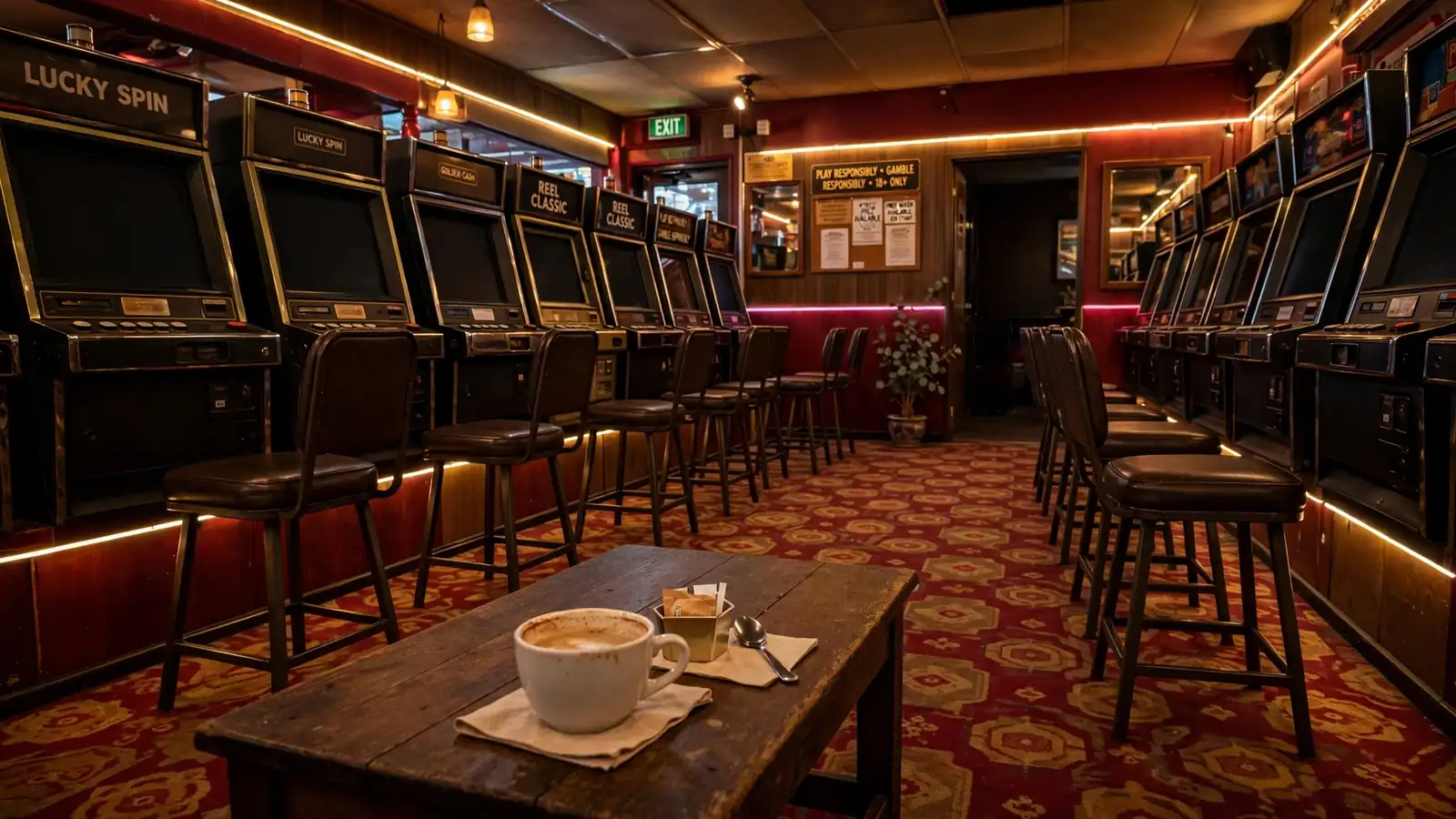
In Australia, “pokies parlour” is an informal way of describing a place where people go to play poker machines. It can also be used loosely in conversation for a room or gaming area within a larger venue. The phrase is familiar, but it does not identify one standard kind of business. Most importantly, it does not tell you that the place is a full-scale casino.
That distinction matters because the words people use casually and the categories used for licensing are not interchangeable. A venue called a parlour in a conversation, advert or online listing might not be a casino at all. The label alone tells you very little about who runs the venue, what licence applies or what kind of premises you are looking at.
I’d treat “pokies parlour” as a description, not a formal status. It gives you a rough idea of the activity someone has in mind, but not a reliable answer about the venue itself. The same goes for “pokie parlour” or “parlour casino”: putting “casino” beside “parlour” does not turn an informal label into proof that the property is a casino.
Choosing a pokies parlour-style casino in Australia means weighing the available licensing and payment details before you play. Use these short verdicts as a starting point, and check the operator’s current terms for information that matters to you.
Uptown Pokies
Uptown Pokies has operated since 2017 under a Curacao licence. The minimum deposit is A$20.
Neospin
Neospin is licensed by the Curacao Gaming Control Board under OGL/2023/176/0095, with Hollycorn N.V. named as the licensee.
Playfina Casino
Playfina Casino operates under a Curacao eGaming licence, with Hollycorn N.V. and a history dating to 2017. Its minimum deposit is A$20–30, depending on the offer.
JustCasino
JustCasino’s stated licensing detail is a licence from the Curacao Gaming Control Board.
SkyCrown
SkyCrown is licensed by the Tobique Gaming Commission. Its listed minimum deposit is A$30; stated payout times are around 10–15 minutes for crypto and 1–5 days for fiat.
WinSpirit Casino
WinSpirit Casino operates under Curacao eGaming licence OGL/2024/923/0383, issued to Antillephone N.V. The minimum deposit is A$30.
Ricky Casino
Ricky Casino lists a A$20 minimum deposit, or A$30 to qualify for the bonus. Stated payout times are under an hour for crypto and 1–3 business days for PayID.
Wild Tokyo
Wild Tokyo operates under a Curacao licence and lists a A$10 minimum deposit. Its stated payout times are 30–60 minutes for crypto and 1–5 days for fiat.
7Bit Casino
7Bit Casino is licensed in Curacao and operated by Dama N.V.
MrPacho
MrPacho lists payout times of 30–120 minutes for crypto and 24–72 hours for fiat. Its minimum deposit is A$30.
A full-scale Australian casino is a different matter. Casino properties operate under licences issued by their own state or territory jurisdiction. Australia does not have one national casino licence that covers every property. So when you are trying to establish whether somewhere is a casino, the useful question is not whether someone has called it one; it is whether it is a casino property operating under the relevant local licence.
That local framework is why a casino is not simply a larger version of a pokies room. The term points to a property with a specific licensing position, while “pokies parlour” may be no more than everyday shorthand. The distinction is practical, not fussy: descriptions can be loose, but a licence is tied to a jurisdiction and a property.
One specialist review puts the Australian total at more than twenty full-scale casinos across all eight states. Treat that as a figure reported by that kind of review, rather than as a permanent count: venues and classifications can change. The point for someone trying to understand the terminology is simpler. Full-scale casinos are a defined part of the regulated venue landscape; the phrase “pokies parlour” does not, by itself, place a venue in that category.
You may see the two expressions used together because a person is looking for a casino where pokies are available, or because a listing uses casual wording to describe a gaming venue. That wording can blur two different things: a venue’s broader identity and the specific activity a visitor expects to find there. It is easy to read a familiar phrase as a firm description. I wouldn’t.
A useful way to read the language is to separate three ideas. “Pokies” names the type of machine people are talking about. “Parlour” is a loose description of a place or room. “Casino” refers to a separately licensed property. One phrase may combine all three, but the combination does not settle the venue’s actual category.
That is also why a page title or map label is not enough to identify a casino. If the venue’s own information describes it as a club, hotel or another kind of gaming venue, the casual phrase “pokies parlour” does not override that description. Likewise, seeing “casino” used in promotional wording should not be taken as a substitute for the local licensing context. Names can be suggestive; they are not the same thing as a licence.
For a newcomer, this saves a small but common mix-up. You might be using “pokies parlour” to mean any place with machines, while someone else uses it for a particular room or venue. Neither use automatically means a full-scale casino. If you mean a casino, say casino; if you mean a room or venue where pokies are played, the broader wording may fit better. The distinction is plain enough once you stop treating the terms as synonyms.
So, when you see a reference to a pokies parlour in Australia, read it as informal wording unless the venue’s status is made clear separately. A full-scale casino belongs to the state or territory licensing system. The phrase “pokies parlour” on its own does not establish that status. Short version: words aren’t licences.
Australia’s gambling venues are spread across a large country rather than clustered in one national gaming district. The broad picture is more useful than a single city count: full-scale casinos operate across all eight states and territories, while other kinds of gambling facilities appear in cities and regional centres. If you are trying to place a “pokies parlour” in that map, keep the categories separate; a count of gambling facilities is not a count of casinos.
One specialist venue directory’s snapshot counted gambling facilities in 147 Australian cities. Treat that as a directory’s reported coverage, not a permanent census: venues open, close and change classification, and the figure describes the directory’s view at a particular point. It still gives you a sense of the spread. Gambling locations are not confined to the biggest capitals, even though major cities are prominent in the overall picture.
The same specialist directory identified Sydney, in New South Wales, as the country’s largest gambling city, with 11 gambling facilities in its count. That is a city-level tally, not a claim that Sydney has 11 casinos. Nor does it tell you that every facility is a casino or a pokies parlour. The distinction matters when you are planning around a particular type of venue: a broad directory result can show where gambling is present without telling you precisely what you will find at each location.
The Northern Territory offers a smaller-scale example of how those counts can look beyond the largest capitals. In that directory snapshot, the Territory had three casinos across three cities. Alice Springs was identified as the city with the most casinos there, with one. The wording sounds modest because the count is modest. It is still a useful reminder that the national footprint is not simply a list of capital-city destinations.
For a newcomer, the practical takeaway is to think in layers. Start with the state or territory, then the city, then the specific venue category. A search result that groups gambling facilities together may be useful for orientation, but it cannot settle whether a location is a full-scale casino, a club or another gaming venue. The label attached to a place matters more than its appearance on a broad map.
The figures also resist neat rankings. A city can lead a directory’s count of gambling facilities without leading in casino numbers, and a territory can have several casino locations spread across separate cities while each individual city has a small count. Those are different ways of measuring presence, not competing versions of the same league table.
So, when you picture the Australian footprint, picture a network across the states and territories, with Sydney prominent in one specialist directory’s city tally and a more dispersed pattern in the Northern Territory. The figures are a guide to geography, not a promise that every listed place has the same kind of venue. Keep that distinction in view. A map is only the start.
Identified as the country's largest gambling city with 11 gambling facilities in one specialist directory count.
Featured three casinos across three cities, with Alice Springs identified as the city with the most (one).
Full-scale casinos operate across all eight states and territories, rather than being clustered in one district.
A name on a map is only useful if it takes you to the right property. When you are comparing descriptions of a “pokies parlour” with casino listings, keep the distinction clear: the addresses below identify named casino properties. They are not evidence that each place is a parlour, and three examples cannot stand in for a national directory.
Lasseters Casino is at 93 Barrett Drive, Alice Springs, NT 0870, Australia. That full address gives you a street and number as well as the town and territory, so it is the clearest locator of these three. If you are checking a review or a map result, match the Lasseters name to Barrett Drive in Alice Springs rather than relying on a broad label such as “casino” or “pokies”. A result that shares a town name is not automatically the same property.
The Gold Coast listing uses a different kind of location detail. Jupiters Gold Coast Casino & Hotel sits on Broadbeach Island, Gold Coast. Keep the complete venue name attached to the place when comparing listings. “Jupiters Gold Coast” and “Broadbeach Island” belong together in this address description, while a generic Gold Coast result may refer to something else.
Country Club Casino has its location given through a road, locality and regional area: Country Club Avenue, Prospect, within Meander Valley. That is more specific than simply saying “Tasmania” or “the country”, but it is not written in the same format as the Lasseters address. Preserve the spelling and the sequence of place names when you check a listing. A partial match can be misleading when the venue name is familiar but the locality is not.
The practical point is simple: compare the venue name and the location as a pair. In a review, look for the actual property being discussed, not just a phrase such as “pokies parlour” in a heading. A review of a casino does not turn that casino into a parlour, and a listing that uses casual wording does not replace the venue’s formal name or address. If the page gives only a broad city label, it may not tell you which property the writer means.
These examples also show why a short address list should not be read as a map of every gaming venue in Australia. Alice Springs, the Gold Coast and Meander Valley are distinct place references, and the three listings offer concrete points to verify—not a ranked selection or a claim about which property is better. I’d treat a venue review as useful only when its name and location line up. Small check, fewer wrong turns.
Before setting out, check the venue’s current entry information and bring valid photo ID. Casino entry is restricted to adults: the minimum age is 18 across Australia. That national threshold is the useful starting point, but it does not replace the venue’s own entry requirements. If you are planning a visit with someone younger, do not assume that being accompanied makes casino areas accessible to them.
You may see references to VIP areas or parlours when looking into a casino visit. Treat those as descriptions of access or a particular part of a venue, not as a promise that every visitor can walk in. Check directly with the venue if you need to know whether a particular area is open to you and what its entry arrangements are. A quick check beats arriving with the wrong expectation.
Major Australian casinos operate around the clock, so the main venue does not simply shut for the night. Still, 24-hour operation is not a guarantee that every service, room or event is available whenever you arrive. If your plans depend on a specific facility or activity, confirm it before leaving. Late-night opening is handy; guessing is not.
I would keep the practical checks simple: confirm the venue’s access information, carry valid photo ID and make sure the place you intend to visit is open to you. A casino’s general operating hours answer one question, not every question about entry. That distinction matters most when you are travelling specifically for a particular area or experience. No drama—just check first.
A national machine total can sound more revealing than it is. The recorded figure for gaming machines installed in Australian casinos and endorsed under venue licences is 3,308. That describes the casino sector as a whole; it does not tell you how many machines sit in a particular room, venue or parlour.
That distinction matters when you are trying to make sense of a local label such as “pokies parlour”. The wording may describe a gaming area or be used informally, but it is not a way to read a venue’s machine count from a national figure. A parlour’s size, layout and machines cannot be inferred from the total.
I would treat the number as a broad snapshot, not a guide to what you will find on arrival. It combines machines across casino venues, rather than breaking them down by city, property or individual gaming floor. So it cannot tell you whether one place has more machines than another, or whether a particular parlour has any specific number.
There is also a difference between a machine being included in the casino total and knowing what is available to visitors at a given time. The total alone does not describe a venue’s current layout or operating arrangements. For that, the relevant detail would have to come from the venue itself.
In short, 3,308 is a sector-wide count tied to casino licences and installed machines. It is not a count of parlours, and it should not be used as a proxy for any single venue. Useful context, but not a floor plan.
A site can load on your phone, let you create an account or appear under a new web address. None of those things proves that it is authorised to provide online casino games in Australia. I’d keep that distinction clear: technical access is about whether a page opens; legal status is about what the service is offering people in Australia.
The Interactive Gambling Act 2001 prohibits operators from providing real-money online casino games to people physically located here. That includes casino-style games such as slots, poker and table games. So a website describing itself as an online pokies parlour, or presenting casino games in a polished lobby, is not evidence of an Australian-licensed online casino. The name and presentation do not change the legal position.
The same applies if a familiar address stops working and another one appears. A domain can be blocked or cease to resolve through an Australian internet provider, while an alternate address may later show up. That change tells you about access to a web address, not whether the operator has approval to offer the service in Australia. An open page is not a licence.
The Australian Communications and Media Authority (ACMA) is the federal regulator responsible for enforcing the Interactive Gambling Act and monitoring compliance with federal interactive gambling rules. When it identifies a prohibited service or advertising for one in Australia, it can ask internet service providers to block access to the relevant website.
ACMA’s published enforcement record describes more than 1,455 illegal gambling and affiliate websites being blocked from November 2019 onward, after enforcement action. Blocking is one part of that work. It can affect which domains Australian users can reach, but it is not a certification system: a site that remains accessible has not thereby been cleared or authorised.
The reported count of illegal services withdrawing from Australia since ACMA began enforcing the rules in 2017 is not consistent across accounts. One figure says more than 210 services withdrew; another puts the total above 190. Either way, the point is that enforcement has led services to leave the market, while the different totals should not be merged into a single precise count.
If you are looking at a site that offers real-money casino play to people in Australia, its account functions, branding or alternate domain cannot establish that the offer is lawful. Nor does a page being unavailable, by itself, tell you the full reason for the problem. A block may affect access to a domain; it does not turn a working replacement address into an authorised service.
Free-play wording needs the same careful reading. A practice or promotional mode is not proof that a real-money service is permitted, and it does not establish the status of other parts of the site. Keep the claims separate: what a page lets you do, what it says it offers, and whether that offer is allowed under Australian law are different questions.
I would not use a working link as reassurance. ACMA’s blocking action and the appearance of alternate domains are about enforcement and access, not a shortcut for verifying legal status. The sensible boundary is straightforward: an online casino site being reachable from Australia does not mean it is an Australian-licensed casino.
A “no-deposit” or sign-up bonus can sound like a simple welcome: create an account, receive a credit, and start playing without putting money in first. But that wording is a promotional claim, not proof that the service is authorised to offer online casino gambling to people in Australia. The same goes for a message promising a bonus after registration or linking one to a first deposit.
That distinction matters here. Under the Interactive Gambling Act 2001, operators cannot provide real-money online casino games to people who are in Australia. A bonus does not change the nature of the service or make it lawful for an operator to provide it. Nor does a sign-up page, a functioning account area or an accessible website amount to Australian approval. I would treat those as separate questions: what the promotion says, and whether the service may legally be offered to someone here.
If a promotion is described as “no deposit”, look for what the phrase actually means in the terms attached to it. Does it refer to a credit, access to a feature, or something that can be withdrawn? Are there conditions on when it applies, who can claim it, or what happens after registration? A headline may leave those details out. The conditions are not fine print to ignore; they define the offer being described.
The same care applies to a sign-up bonus connected with a deposit. The wording may suggest a straightforward match or reward, while the terms may set conditions for eligibility, use or withdrawal. Do not assume a phrase such as “claim on registration” means the benefit is unconditional, available to every visitor or usable as cash. If the terms are unclear, inconsistent with the headline or difficult to find, that is a reason to be cautious about the claim—not a reason to fill in the gaps yourself.
It is also worth separating “no deposit” from “no cost” or “no risk”. Those are not interchangeable promises. A promotion may come with requirements that affect whether a benefit can be used or withdrawn, and a sign-up message cannot tell you the full picture by itself. Read the actual conditions rather than relying on a banner or a short description.
Still, even clear terms answer only the promotion question. They do not establish that an online casino service can legally accept Australian customers. Different tests.
A site can display a sign-up bonus, accept account details or appear under another web address without being an Australian-licensed online casino. Accessibility is not authorisation, and changing the domain does not change the legal position. So a polished registration page—or a message that appears to be tailored to Australian visitors—should not be treated as evidence of local approval.
The law applies to the operator’s service, not the name it gives a promotion. Calling a credit a welcome reward, a registration benefit or a no-deposit offer does not create an exception for online casino gambling. The Interactive Gambling Act 2001 prohibits operators from supplying real-money casino-style games to customers located in Australia. That is the relevant boundary when a promotion leads into online casino play.
This is why the order of checks matters. First, understand what the promotional words claim and what the attached conditions say. Then keep that separate from the legal status of the service. A detailed set of terms can explain how a promotion is presented, but it cannot establish that the operator is permitted to provide the underlying casino service in Australia. And a message saying “available to Australian players” is still only a message.
If you are assessing wording you have already encountered, save the page or note the exact claim and its terms before they change. Keep the record for your own reference; do not treat it as a recommendation or a signal to register. Promotions can be revised, removed or displayed differently across pages, so a headline copied elsewhere may not reflect the conditions currently shown by the service.
The useful conclusion is modest: “no deposit” describes how a promotion is marketed, not whether the service is authorised here. A sign-up bonus does not establish Australian licensing, and an accessible account page does not either. Keep the offer’s wording and the operator’s legal status in separate boxes. A banner cannot settle both.
“Free spins” and “free chips” are promotional labels, not proof that a player will receive anything or can use it in the way the headline suggests. If you see them attached to a page describing a pokies parlour or casino, read them as claims made by that page. The wording alone tells you neither what is included nor whether the service is lawful for people in Australia.
The same goes for a claim that something is free. It may describe a promotional condition, rather than an unconditional benefit. The full terms could set out who qualifies, how the credit can be used, whether it expires, or whether other conditions apply. Without those terms, there is no sound basis for assuming that a headline tells the whole story. A bright banner is not the fine print.
There is also a more basic distinction to keep in view: promotional language does not turn an online service into a locally authorised one. Under the Interactive Gambling Act 2001, operators are prohibited from providing real-money online casino games to people in Australia. That includes online casino-style games such as slots and table games. Calling an incentive “free” does not, by itself, change the nature of the service or establish that it may be offered here.
I would separate three questions when reading this kind of claim. What exactly is being offered? What conditions apply? And what is the status of the service making the offer? A clear answer to one does not answer the others. A page might spell out a promotion while leaving its legal status unclear; a polished presentation is no substitute for that distinction.
“Free chip” can be especially vague because the phrase does not explain whether it refers to a casino promotion, a game feature, or simply wording used to attract attention. “Free spins” is similarly incomplete: the label does not tell you the applicable terms or prove that the advertised arrangement is available to Australian users. I wouldn’t treat either phrase as a promise until its meaning and conditions are clear—and even then, that only clarifies the claim, not the provider’s status.
This is different from an in-person visit to a locally licensed casino. A digital page using familiar casino language is not evidence that it is connected to a physical venue, or that the same rules apply. The words may sound familiar; the setting is not necessarily the same.
If the wording feels designed to make you focus on the supposed free item and skip over everything around it, slow down. Look for the actual terms and the identity of the service behind the page. Don’t infer that an offer is guaranteed, suitable for Australian users, or lawful simply because it is labelled free. Free is a headline, not a verdict.
A bonus headline can make an offer look straightforward. The small print is where its limits tend to live. If you come across a promotion described as a parlour or pokies bonus, treat the wording as a claim to examine—not proof that the offer is available to you, or that the service behind it is authorised for Australians.
Start with what the promotion actually says. Look for the terms that explain who may qualify, what actions are required, which games or services are included, and when the offer stops applying. Check whether the headline and the detailed conditions describe the same thing. If key conditions are unclear or hard to find, you cannot reliably tell what the banner promises.
That is separate from checking the service’s status. A site may load, accept account traffic or appear under another domain; none of those things establishes that it is an Australian-licensed online casino. Nor does adding a bonus label change the rules that apply to the service. Under Australia’s Interactive Gambling Act 2001, operators cannot provide online casino games to people in Australia.
I would keep those checks in that order: understand the claim, then consider whether the service can lawfully provide what it is advertising here. A polished page can make both questions feel settled before you have answered either. It has not.
Be alert to wording that blurs the offer’s scope. A general “bonus” may not tell you whether it relates to an in-person venue or an online service, what conditions attach to it, or who can use it. Don’t fill those gaps with assumptions based on a logo, a familiar name or a page that opens. Ask what the promotion covers and read the conditions before treating its headline as meaningful.
The useful distinction is simple: promotional wording describes what a business claims to offer; it does not verify the conditions or establish Australian authorisation. If either point remains unclear, the banner has not given you enough to rely on.
A real-money casino site can look polished, accept account activity and load on your screen. None of that makes it an Australian-licensed online casino. The important distinction is legal, not technical: a working website is not evidence that its service is authorised for people in Australia.
Under the Interactive Gambling Act 2001, operators cannot provide real-money online casino games to people physically located in Australia. That covers casino-style play such as slots, poker and table games. So if you are looking for an online version of a pokies parlour, don’t treat a familiar layout or an account prompt as proof that the service is lawful here.
The rule is about the operator’s conduct. Players do not face a fine or criminal prosecution simply for playing at an offshore casino, but that does not turn the service into an authorised Australian option. An offshore licence, where one is claimed, is not an Australian licence. And a site’s availability does not change that.
I would keep the check simple: separate the question “Can I open this site?” from “May this operator provide real-money casino games to people here?” They are not the same question, and the first cannot answer the second.
For an Australian player, real-money online casino access sits on the wrong side of the legal boundary, even when the site appears ready to take an account. If you need to check the law or an enforcement matter, consult the Australian Communications and Media Authority or the legislation itself rather than relying on a site’s own claims. Looks convincing. Still not authorisation.
Prepared by the VegasNow Casino editorial staff.