We use cookies to enhance your experience, analyze traffic, and personalize ads. Please accept or manage your preferences.
A practical guide to browser play, deposits, offers and the limits of what “Australian mobile casino” can mean.
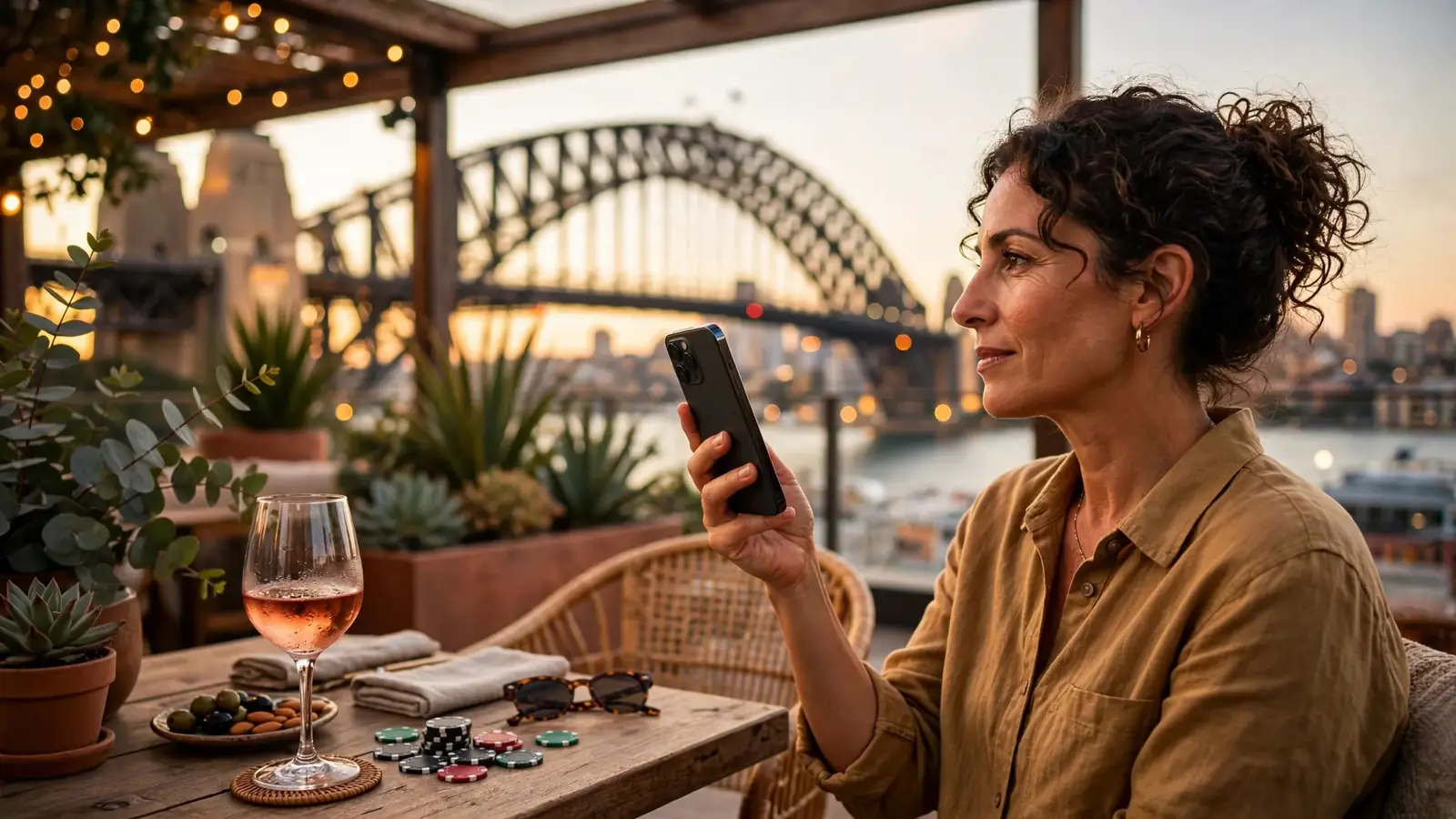
On a phone, the simplest route to a casino website is often the one already in your hand: open a mobile browser and enter the address. For Australian visitors, browser access is the normal starting point. The same account can generally be used on a phone and a desktop, so there is no separate mobile profile to set up.
That matters because a dedicated app is not always an option. Casino apps are uncommon in the Australian versions of Google Play and the Apple App Store. A site may instead be designed to load in a browser, or offer a Progressive Web App (PWA) that can sit on your home screen. Neither route requires you to assume that a familiar-looking app listing exists.
A browser gives you a quick way to see how a site behaves on your particular device. Open its address in your usual browser and let the page finish loading before tapping around. If you already have an account, sign in there; a mobile browser is not a different service, but a smaller screen and touch controls applied to the same account.
I find it useful to begin with the browser even when a PWA is available. You can check whether the page fits the screen, whether menus respond to taps, and whether text is readable without installing anything. If the page is awkward, adding it to the home screen will not necessarily fix that. It is still the website underneath.
Keep the browser current and close apps you do not need if a page is struggling. Poor reception can interrupt loading, while limited available memory, an older browser, or several apps running in the background can also make mobile pages behave badly. A specialist review identifies those as common sources of phone-side trouble. A refresh may help with a temporary loading snag, but it will not solve every underlying issue.
A Progressive Web App is a website shortcut with an app-like place on your phone. Rather than downloading a separate casino program from an app store, you install the shortcut from the website itself. The site may show an install or add-to-home-screen prompt; tap it and confirm when your device asks. The shortcut then appears among your phone’s icons and can open the site in a more app-like window.
The detail worth remembering is that a PWA is still tied to the website. It is not proof that the service has a separately verified app, nor does the shortcut itself make a site safer or more reliable. If the site changes or is unavailable, the icon cannot make it work independently.
The exact prompt and where it appears can vary between browsers and devices. If no prompt shows, look in the browser’s menu for an option to add the page to the home screen. Do not install a file from an unfamiliar download page just because it claims to be an app. Sideloaded casino apps carry security risks, and their safety depends on the operator; a browser shortcut avoids installing that kind of separate app file.
Before settling in, check a few basics on the phone itself:
A page that freezes does not automatically mean the phone is at fault. Try the browser again after checking the connection and closing other apps. If the same problem persists, the site itself may be responsible. That distinction saves a lot of aimless tapping.
For a first visit, I would keep it simple: open the site in a mobile browser, see how it handles on your device, and only then decide whether a home-screen shortcut is useful. Browser access is familiar, easy to undo, and usually enough to get around. The PWA is an optional convenience, not a required upgrade.
A casino page can look polished on a large screen and feel awkward on a phone. I pay attention to the small practical things: whether the menu stays manageable, whether text is readable without constant zooming, and whether buttons are easy to distinguish from nearby links. A crowded screen is not just unattractive; it makes it harder to tell what you are tapping.
Start with navigation. Can you reach the games area without digging through several layers of menus? Are categories clearly labelled, and does the page keep your place when you return from a game description? A search box can help when a catalogue is large, but it should be easy to find and should not crowd out the basic controls. If you cannot work out where you are, more games will not fix that.
Then look at how the catalogue is presented. A useful mobile layout gives each title enough room for its name or image to be recognised, rather than squeezing a wall of tiny tiles onto the screen. Check whether category filters are visible and whether they are easy to clear. If the page has a favourites feature or recently viewed area, see whether those controls are obvious; do not assume a feature exists just because a desktop version has it.
Descriptions matter, too. A title’s information should open in a way that does not cover the whole screen without a clear route back. Notice whether the page explains the basic controls and whether help or rules are reachable from the game view. This is a check on presentation, not a reason to rush into a game. If key information is missing or difficult to read, that is a fair reason to stop browsing.
Images and animations can make a catalogue feel lively, but they also add visual clutter. Give the page a moment to settle, then check whether scrolling remains predictable and whether the controls respond as expected. A specialist review identifies poor connection, limited device memory, an outdated browser and too many apps running in the background as possible causes of mobile casino problems. That is useful context: a stuttering page does not automatically tell you whether the site itself is at fault. Close other apps, check your connection and try an up-to-date browser before drawing a conclusion.
When looking at mobile pokies, check whether the display fits the phone in both portrait and landscape orientation. Some games may be easier to read turned sideways, while others may keep important buttons too close to the edge. Text should remain legible, and controls should not be hidden behind browser bars or cut off by the screen. If the layout forces repeated zooming or awkward scrolling, the mobile version is not doing its job.
It is also worth noticing what happens when you leave a game and return to the catalogue. Does the page reload from the beginning, or can you pick up where you were browsing? Do filters still make sense? These details shape the experience of browsing mobile slot games far more than a long list of titles does. “More choice” is not much help if finding anything becomes a chore.
People often use phrases such as best mobile slots when what they really need is a way to compare how games are displayed and explained on a small screen. I would start with usability, not a claim that one title is best. Check the catalogue calmly, see whether the interface is clear, and stop if the page feels confusing or unreliable. No need to fight your phone.
The key distinction is between the rules for operators and the position of an individual punter. Under the Interactive Gambling Act 2001, operators are prohibited from offering online casino-style games to people in Australia. That covers services such as online casino play, rather than making the act of accessing an offshore mobile casino an offence for the individual.
So the legal position is not simply “casinos are allowed” or “players are breaking the law”. The restriction is directed at the provider’s offer to people located in Australia. An offshore service may be reachable on a phone, but that does not make its offer lawful under Australian rules. Access and legal permission are different things.
That distinction can be easy to miss when a site appears polished or presents itself as available to Australians. A mobile casino’s branding, language or payment options do not change the rule applying to operators. Nor does a foreign licence override the Australian restriction. The relevant question is not whether the site looks local; it is where the service is offered and which law applies to that offer.
ACMA, the Australian Communications and Media Authority, actively blocks access to illegal gambling sites. As a result, a site that a punter has encountered before may later become inaccessible from Australia. Blocking is part of the regulator’s enforcement approach, not a verdict that a particular player has committed an offence. A blocked page also does not, by itself, tell you whether another address or version of a site is trustworthy.
Offshore operators associated with Australian customers may refer to licensing jurisdictions such as Curaçao, Malta or Gibraltar. The Malta Gaming Authority is a regulator; Curaçao and Gibraltar are also jurisdictions linked with offshore licensing. Those references describe where a licence may come from, not permission to provide online casino games to people in Australia. A foreign licence and compliance with Australian law are separate matters.
I would treat licence details as context, not reassurance. A jurisdiction named in a footer does not establish that Australian rules permit the service, and it does not remove the risk that ACMA may block access. Likewise, being able to open a page on a phone is not proof that the operator is authorised to offer casino-style games here. Reachable is not the same as permitted.
Searches for mobile casinos in Australia often blur these points together: a site can be offshore, accessible for a time and still fall within the category of services operators are prohibited from offering to people in Australia. The law places the relevant prohibition on the operator, while the Act does not make an individual player’s offshore play illegal. Keeping those two positions separate gives a clearer picture of the rules without mistaking access for approval.
Deposit menus vary between offshore crypto-friendly casino services, so a payment method mentioned on one site may not appear on another. A specialist review describes PayID, BPAY, cards and cryptocurrency among the options that may be offered for mobile deposits, with processing times differing by method. Treat that as a description of possible menus, not a promise that a particular option will work for you.
PayID is often presented as a quick way to add funds: a specialist review characterises deposits as near-instant and typically free. Before using it, check the amount and any fee shown on the payment screen, then make sure you follow the site’s instructions carefully. A payment can be delayed or rejected if details are entered incorrectly or the service does not support the method for your account.
POLi is a historical option, not a working route for Australian transactions. Its Australian service ended in September 2023, so a page that still presents POLi as an available local payment method may be out of date. Don’t try to work around that by choosing a different country or entering details that do not match your own.
Cards can be listed alongside bank-based options, but a card symbol does not mean a charge will go through. A specialist review notes that some Australian banks block or flag gambling-related card transactions, which can lead to a declined deposit. If that happens, check with your bank rather than repeatedly submitting the same payment. Do not assume that a failure means your account has been charged; check your banking app and the transaction status first.
BPAY and cryptocurrency may also appear on some mobile deposit screens, according to a specialist review. Their processing can differ from PayID or a card payment, and the screen should explain what to do next. With cryptocurrency, take extra care to match the requested asset and transfer details. A transfer sent to the wrong address or through an unsupported route may be difficult to recover. That is not a minor typo.
Before depositing, confirm that the site accepts your location. Offshore casino access is actively blocked by ACMA, and using a VPN to reach a blocked service may result in winnings being voided and your account closed. If an offshore service refuses to pay, there is no Australian government body for you to complain to. Those are material risks, not payment-screen fine print.
I’d pause before confirming any deposit and read the displayed method, amount, fees and processing information from top to bottom. Keep a record of the confirmation and check your bank or payment account afterwards. If the method or terms are unclear, don’t proceed. A payment option being visible on a phone is not proof that it is suitable, available to you, or protected by Australian oversight.
A no-deposit offer may sound as though you can claim something and cash out without any further steps. That is not how the first withdrawal works. Even if an offshore crypto-friendly casino advertises a mobile offer, the offer itself does not remove identity checks or guarantee that a balance can be paid out.
Expect the casino to request KYC verification before processing a first withdrawal. That can mean providing identification, a selfie and proof of address. Check that you can supply the required documents and that the details on your account match them. A mismatch or missing document can hold up a request while the casino asks you to correct it. A phone screen makes uploading easy enough; it does not make the review disappear.
Payment rules can also affect whether you can withdraw. A specialist review notes that some casinos require a withdrawal through the same method used for the deposit, while other methods may be available only for deposits. Read the cashier rules before accepting an offer or putting money in. If the only available deposit route cannot be used for payouts, you need to know what alternative the casino permits and whether extra checks apply.
There may also be a cap on how much can be withdrawn in a given period. A specialist review reports that some casinos set weekly or monthly withdrawal ceilings, with reported weekly figures in the $4,000–$10,000 range. Treat that as a possible operator-specific restriction, not a market-wide standard: check the current terms for the particular site. A cap can matter even when a balance is approved, because payment may be split across periods rather than arriving in one transfer.
Before engaging with a no-deposit mobile casino offer, confirm that the site accepts your location before depositing. Do not use a VPN to get around a block: it may lead to account closure or voided winnings. And remember that an offshore service is not an Australian-licensed casino. If it refuses to pay, there is no Australian government body to handle a complaint about your winnings.
The practical test is simple: can you verify your identity, use a permitted withdrawal route and accept the stated payout cap? If any answer is unclear, pause before claiming. “No deposit” describes how an offer begins, not what happens when you try to take money out.
Choosing a mobile casino for 2026 means weighing the details that matter to you, such as licensing, minimum deposits and payout information. Use this list as a quick reference to the details available for each operator.
Uptown Pokies
Uptown Pokies has operated since 2017 under a Curacao license. You can start with a minimum deposit of A$20.
Neospin
Neospin is licensed by the Curacao Gaming Control Board under OGL/2023/176/0095, with Hollycorn N.V. named as the licensee.
Playfina Casino
Playfina Casino is licensed by Curacao eGaming, with Hollycorn N.V. named as the licensee, and has operated since 2017. Your minimum deposit is A$20–30, depending on the offer.
JustCasino
JustCasino is licensed by the Curacao Gaming Control Board.
SkyCrown
SkyCrown is licensed by the Tobique Gaming Commission. You can deposit from A$30; stated payout times are around 10–15 minutes for crypto and 1–5 days for fiat.
WinSpirit Casino
WinSpirit Casino is licensed by Curacao eGaming under OGL/2024/923/0383, with Antillephone N.V. named as the licensee. Its minimum deposit is A$30.
Ricky Casino
Ricky Casino lists crypto payouts in under an hour and PayID payouts in 1–3 business days. The minimum deposit is A$20, or A$30 to qualify for the bonus.
Wild Tokyo
Wild Tokyo is licensed in Curacao and has a minimum deposit of A$10. Stated payout times are 30–60 minutes for crypto and 1–5 days for fiat.
7Bit Casino
7Bit Casino is licensed in Curacao and operated by Dama N.V.
MrPacho
MrPacho lists crypto payout times of 30–120 minutes and fiat payout times of 24–72 hours. Its minimum deposit is A$30.
The phrase describes how an offshore casino can be reached on a phone; it does not mean the service is licensed in Australia or available to everyone here. A mobile-friendly website may load on a device, but that alone says nothing about whether the operator accepts your location. Any services discussed in this context are offshore and crypto-friendly, not Australian-licensed casinos.
That distinction matters because the Interactive Gambling Act 2001 prohibits operators from offering online casino-style games to people in Australia. The Act does not make it illegal for an individual Australian to play at an offshore casino. Those are different sides of the law, and mixing them up gives you a poor picture of the risks.
Some operators that accept Australians are associated with licensing jurisdictions such as Curaçao, Malta or Gibraltar. A foreign licence is not an Australian licence, and it does not guarantee that the operator will accept customers from every Australian state or territory. Before you deposit, confirm directly with the site that it accepts your location. If that information is unclear, treat that as a reason to pause rather than guess.
Access can be unreliable for another reason: the Australian Communications and Media Authority blocks illegal gambling sites. A site that is unavailable from your connection may be blocked, rather than simply experiencing a temporary technical fault. Trying to get around a block with a VPN can create further problems. Operators may treat VPN use as a breach of their terms, which can lead to an account being closed or winnings being voided. Not worth the gamble.
Also be cautious about installing an app from outside the official app stores. Sideloaded casino apps carry security risks, and their safety depends on the operator behind them. A familiar-looking icon is not proof that an app is genuine or that it handles your information safely. I would not install one unless I had checked who supplied it and understood the risks.
The biggest practical gap is what happens if an offshore operator refuses to pay. There is no Australian government body you can complain to that will resolve an unpaid offshore casino win for you. You may have to deal with the operator or a process in its licensing jurisdiction, and there is no guarantee of a useful outcome. Keep that in mind before sharing personal details or putting money into an account.
So, “Australian” in this phrase is about the audience or intended access, not local approval. Check location eligibility before depositing, do not use a VPN to bypass a block, and assume you will have limited local recourse if a dispute goes badly.
If you want a casino-style game on your phone without staking money, social and free-play apps are a separate category from real-money gambling services. They use virtual credits for play, so the activity is centred on the game experience rather than wagering cash. That distinction matters: a balance shown inside an app is not the same thing as money held in a gambling account.
In Australia, these free-play apps are legal to use and can be downloaded directly from the Google Play Store or Apple App Store. That makes them a straightforward option when you simply want to try casino-themed mobile games on a familiar device. You do not need to look for an offshore service to find this kind of play.
I’d still take a moment to check what an app actually offers before installing it. Read its store description and look at the permissions it requests. Then check whether it is described as a social or free-play app using virtual credits, rather than a service involving real-money gambling. The labels and presentation can look similar at a glance; the way the app handles play is what separates them.
Also check the app’s own details for how virtual credits work. “Free-play” describes the play format, but it does not tell you every detail about the app’s features or any optional purchases. If you do not want to spend money, review the purchase information before you start and avoid treating extra credits as necessary. A game can be free to download while still presenting choices inside the app.
On a phone, the appeal is simple: you can open a game for a short session without setting up a real-money gambling account. The trade-off is that virtual credits belong to the app’s play system. They are not a cash balance, and the experience should not be confused with a way to earn or withdraw money.
If you are comparing several apps, focus on the description, credit system and whether the experience matches what you want. New releases may appear in either app store, but “new” does not automatically mean better suited to you. I’d start with the store listing, keep the distinction between virtual credits and cash clear, and leave it there if the app’s terms are unclear. Simple enough.
Free mobile pokies and crypto casinos can appear side by side in a search, but they describe different things. A free-play app gives you virtual credits to use inside the app; a crypto casino involves real-money gambling and cryptocurrency. The word “free” does not make the two interchangeable.
Social casino apps that use virtual credits are available through the Google Play Store and Apple App Store, and Australians can use them legally. Those credits are for play within the app, not cash in a wallet. They cannot be treated as a balance you can withdraw or convert into cryptocurrency. If an app presents virtual credits as though they were winnings you can cash out, read the wording carefully.
The same distinction matters when you see a mobile casino signup offer described as free. An offer may involve real-money play, while a free-play app uses credits that have no cash value. The label alone tells you little about what you can do with the balance. Check whether the service is a social game or a real-money gambling service before sharing payment details or assuming a displayed balance can be paid out.
PayID and crypto also serve different roles. PayID is a payment method; cryptocurrency may be used for deposits or withdrawals at some services. Neither turns virtual credits from a free pokies app into money. A free mobile game can be a way to pass time, but it is not a trial balance that automatically carries over to a separate crypto service. Two different lanes.
Withdrawal timing is another practical difference. Free-play apps using virtual credits do not make cash withdrawals of those credits. For crypto withdrawals from gambling services, a specialist review reports processing in under 24 hours; that is a reported timeframe, not a guarantee for every operator or transaction. The service may have its own checks or processing steps, so do not assume a figure quoted for crypto applies to app credits, or that it describes the full time before funds reach you.
When a page mixes free pokies, a mobile crypto casino and signup language, separate the claims. Ask what the credits are worth outside the app, whether real money is involved, and whether the stated withdrawal timing is about operator processing or the entire journey. “Free” can mean virtual play, not free cash.
Real-money gambling on a phone can feel less consequential than sitting at a table, because the screen is always within reach. It isn’t. Before considering any offshore crypto-friendly casino, be clear about the risks, the controls available and what could happen if a payment or withdrawal goes wrong. This is a caution, not a recommendation.
You must be at least 18 to register and gamble in Australia. Age eligibility is only the starting point: it does not make an offshore service locally authorised or guarantee that it will accept your location. Confirm that the site accepts people where you are before depositing. Do not use a VPN to get around a block or location restriction; doing so may void winnings and lead to account closure.
I’d check the account controls before putting money in. Look for options to set deposit, loss and wager limits, restrict session time, or self-exclude. A limit is useful only if you set it before play and stick to it. If you find yourself raising it to keep going, step away instead. A phone makes access easy. That cuts both ways.
Payments can create a separate headache. E-wallets such as MiFinity, Skrill and Neteller are used for both deposits and withdrawals, but a payment method shown on the cashier page does not tell you how quickly a withdrawal will reach you. A specialist review reports that e-wallet withdrawals may arrive within 24 hours after the casino’s pending period. That is not a guarantee: the operator’s processing time comes first, and individual conditions can differ.
Before depositing, check whether the method can also be used to withdraw and whether the site imposes a pending period or other withdrawal conditions. Keep a record of the method and transaction details. If a withdrawal is delayed, save your correspondence and account records; an offshore operator may leave you with limited practical options. There is no Australian government body to complain to if an offshore casino refuses to pay winnings.
Free credits, a bonus or a polished mobile casino platform do not remove these risks. Don’t treat an offer as cash, and don’t deposit money you need for essentials. If gambling is becoming hard to control, stop and seek support rather than trying to win losses back.
A mobile casino bonus can look generous on a small screen, where the headline is easy to see and the conditions sit behind another tap. I’d open the full terms before deciding whether an offer is usable. These offers may come from offshore crypto-friendly casinos; a promotion does not make the service locally licensed or mean it accepts your location.
Start with the wagering requirement. It says how much qualifying play is required before bonus funds or related winnings can be withdrawn. A specialist affiliate review describes welcome-bonus requirements in the range of 30x to 50x the bonus amount, and treats anything above 40x as steep. Those figures are a guide, not a promise about any particular offer. Check what the multiplier applies to: the bonus alone, or the deposit and bonus together. That difference can change the amount of play required considerably.
Next, look for the minimum deposit and the deadline. Some offers require a deposit to activate, even when the headline sounds like a no-deposit mobile casino bonus. The terms should state when qualifying play must be completed. Specialist affiliate reviews note that wagering requirements, deposit thresholds and time limits all affect whether an offer is worthwhile. Miss the clearance deadline and the bonus may be removed.
Game restrictions matter too. Terms can exclude certain games or limit how much they contribute toward clearing the requirement. Don’t assume every game on a site counts equally; check the eligible-games list and any contribution rules before claiming.
Then find the cashout cap. It sets a ceiling on what can be withdrawn from bonus play, even if the balance appears higher. Check whether the cap applies to winnings from the bonus and whether other conditions affect a withdrawal.
The same checks apply to a mobile casino bonus code: entering a code may attach specific terms, rather than simply unlocking a better version of an offer. A bitcoin-related promotion also needs its own eligibility and wagering rules; the payment method does not tell you what those rules are.
If the conditions are hard to locate, unclear, or don’t fit how you intend to play, leave the offer alone. Before any deposit, confirm the site accepts your location. A headline is not the contract.
Yes. Social casino apps with virtual credits are available through the Google Play Store and Apple App Store.
Yes. You can use a mobile browser, usually with the same account you use on desktop.
A mobile site or PWA is not automatically safe just because it works on your phone. Avoid installing casino app files from unfamiliar download pages, as sideloaded apps carry security risks.
Yes. Responsible gambling controls can include loss limits, deposit and wager limits, session time limits, and self-exclusion.
No. Most Australian players access casinos through a mobile browser; a PWA home-screen shortcut is optional.
Crypto and e-wallet withdrawals are typically processed in under 24 hours, though an e-wallet payout may arrive within 24 hours after the casino's pending period. First withdrawals usually require identity verification.
Created by the ”VegasNow Casino” editorial team.