We use cookies to enhance your experience, analyze traffic, and personalize ads. Please accept or manage your preferences.
Low volatility points to more frequent, modest wins, but it cannot predict when a spin will pay or how much a game returns.
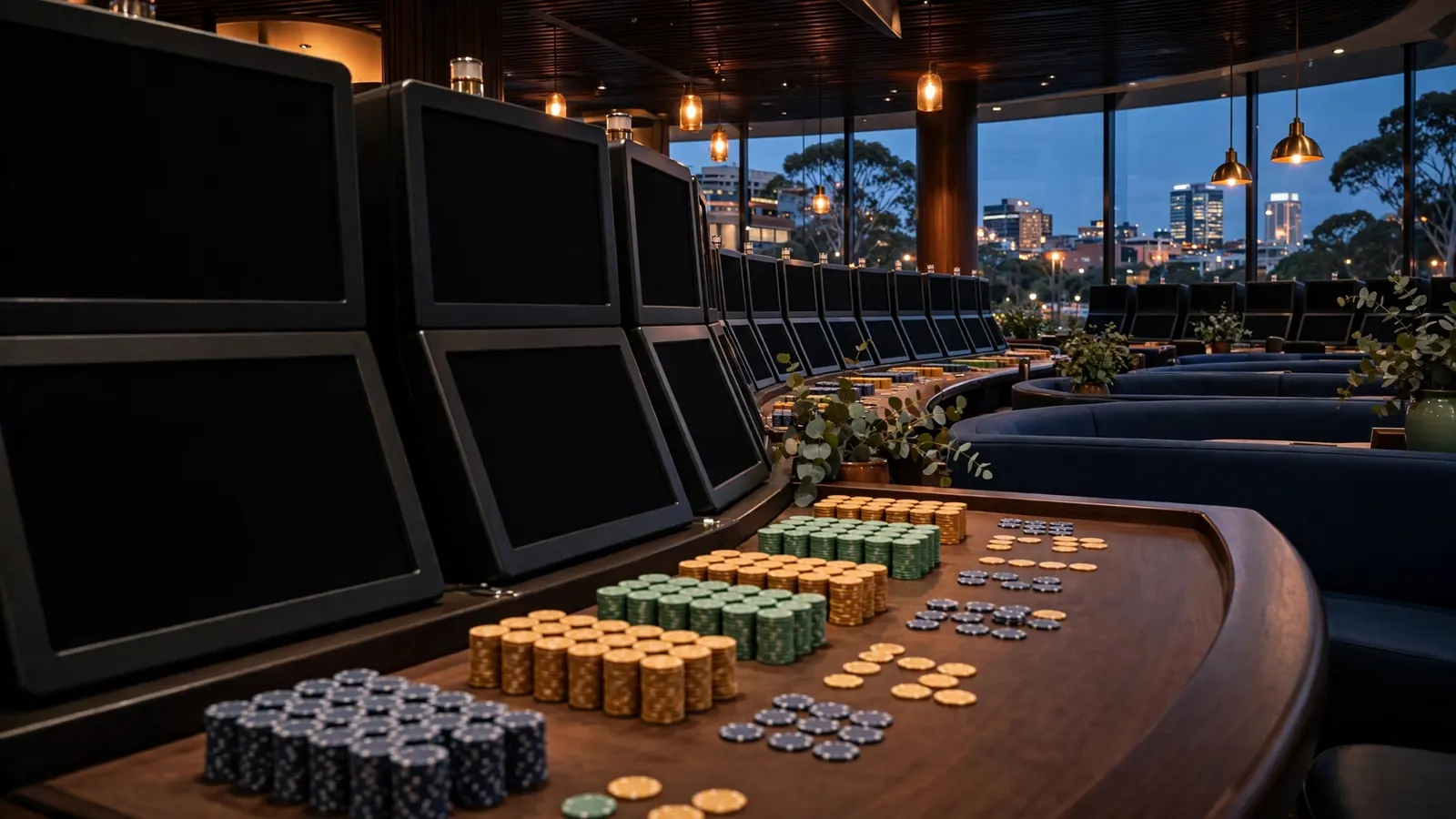
When people describe a pokie as low volatility, they are talking about the general pattern of its wins: smaller payouts tend to appear more often, and the value of winnings tends to fluctuate less sharply. The label is about how results are distributed over play, not a rating of how good a game is or a sign that it will return money.
In plain terms, a low-volatility game is associated with more frequent wins that are modest in size. Those wins may make the balance move in smaller steps rather than jumping between long quiet stretches and unusually large payouts. That is the basic low volatility meaning in pokies: a tendency towards regular, smaller returns and less pronounced variation.
“Frequent” is relative, not a promise that a win will arrive after a particular number of spins. Nor does “low volatility” mean that every spin pays, or that the game will keep producing wins at a steady pace for you. A label describes a broad pattern; it does not schedule the next result. That distinction is easy to lose when a run of small payouts makes a game feel predictable. It isn’t.
The word “volatility” can sound like a technical measure of danger, but in this context it is a way to describe how much payouts tend to vary. A lower-volatility pattern generally has smaller changes in winnings. The point is not that the game has no ups and downs; it is that its payouts are characterised by less fluctuation than a pattern with more pronounced changes.
You can think of the label as a description of the shape of the results, rather than a forecast for an individual session. Two people can play the same low-volatility game and see quite different sequences. One might notice several small wins close together; another might have a quieter stretch. Neither short experience, on its own, rewrites the underlying description.
A win, here, means a payout from a spin. Its size matters alongside how often wins occur. A game that pays smaller amounts more frequently can still produce a balance that moves unevenly, because a run of results is not obliged to match the overall pattern at every point. “Low” is a comparison of volatility, not a promise of smooth progress.
That is why the phrase “low-volatility slot” should not be read as “safe” or “reliable”. It says something about the general size and frequency of payouts, not whether you will finish ahead. A small win is still a payout, but it may not offset what has been spent. The label tells you nothing certain about the outcome of your next spin.
When you come across descriptions of low-volatility pokies, look for the two parts of the claim: how often wins are said to occur and how large those wins tend to be. Frequent small wins may indicate a low-volatility pattern. The size of a payout matters too; frequency by itself does not explain the full picture. If a description mentions only one part, it gives you less to go on.
This also helps separate volatility from a game’s theme or appearance. Bright animations, familiar symbols and a busy screen do not tell you whether payouts are low or high in volatility. The relevant point is the pattern of wins, not how lively the game looks. A quiet-looking game is not automatically low volatility, either.
In Australian conversation, you may hear “pokies” more often than “slot machines”. The terms refer to the same broad kind of game in this context, and the volatility idea is the same: it describes the tendency towards more frequent, smaller payouts and less movement in winnings. It does not turn that tendency into an outcome you can count on.
I find it useful to keep the definition narrow. Low volatility describes a general payout pattern. It does not tell you that a particular spin will pay, that small wins will arrive at regular intervals, or that the overall result will be positive. Small, frequent wins are a clue to the pattern, not a guarantee. That is the whole point.
This page is affiliate-driven and may include sponsored links; this explanation is informational and does not recommend a gambling service. Gambling involves a risk of losing money. Online gambling content in Australia is for adults aged 18 and over.
The practical difference between low- and high-volatility play is not simply “small wins” against “big wins”. It is the way results can move during a session. With a lower-volatility pattern, payouts tend to be smaller and may arrive more often. With a higher-volatility pattern, wins can be less frequent, while some payouts may be larger. Neither pattern promises that a particular spin will pay.
That contrast changes the feel of play. Smaller returns may soften the ups and downs on the screen, while a run without a payout can still happen. Bigger potential payouts can make a high-volatility session feel more uneven: a player may see longer quiet stretches, followed by a more substantial result—or no such result at all. The distinction is about possible patterns, not a schedule.
In a lower-volatility game, modest wins may return some of what has been wagered without creating a dramatic jump in the balance. That can make the session appear steadier. It does not mean the balance will hold level: wagers continue, and small payouts may not cover what has been spent.
Higher-volatility play can produce sharper changes. A sequence of spins without a meaningful return may reduce the balance, while a larger payout, if it occurs, can change it more noticeably. There is no reliable way to know when that might happen. A player who expects a big win because there has been a long dry spell is treating randomness like a timetable. It is not one.
Low-variance games are associated with frequent, smaller payouts, which may help a bankroll go further than a pattern of larger, less frequent returns. “May” matters here. A small payout is not necessarily a net gain, and repeated wagers can use funds even when wins appear along the way. The screen can look busy while the balance tells a less cheerful story.
Lower-volatility games may also have smaller jackpots and payouts than other games. That is one side of the trade-off: a more modest pattern of returns can mean fewer dramatic peaks. A higher-volatility pattern may offer the possibility of larger payouts, but possibility is not a likely outcome for any individual session, nor a reason to keep playing through losses.
I would compare the patterns by asking what kind of fluctuation I am prepared to sit with, rather than treating one as the sensible choice for everyone. If frequent modest returns sound less stressful, lower volatility may fit that preference. If you are comfortable with bigger swings and stretches without a notable payout, higher volatility may feel more familiar. Neither preference changes the underlying risk of losing money.
It is easy to read frequent wins as proof that a session is going well. But a payout can be smaller than the wagers that preceded it, and a run of small returns does not establish that another is due. In the other direction, a quiet stretch does not make a larger win more likely on the next spin. Past results do not provide a dependable forecast.
So when comparing high and low volatility, keep the focus on how uneven the play may feel and how large the payouts may be, not on which one will leave you ahead. Volatility describes a broad style of fluctuation; it does not turn a gambling session into a predictable plan. Keep any spending within an amount you can afford to lose, and stop if the session is no longer comfortable.
This page is affiliate-driven and may contain sponsored links. Gambling carries a risk of losing money; this information is not a promise of returns or a recommendation to gamble. Online gambling content is for adults aged 18 and over.
If you’re looking for low-volatility slots in Australia in 2026, you’ll want to check the volatility of the individual games rather than assume it from the casino name. These notes give you a few verified operator details to consider as you make that choice.
Uptown Pokies
Uptown Pokies has operated since 2017 under a Curacao licence. Its minimum deposit is A$20.
Neospin
Neospin is licensed by the Curacao Gaming Control Board under OGL/2023/176/0095, with Hollycorn N.V. named in the licence details.
Playfina Casino
Playfina Casino is licensed by Curacao eGaming, with Hollycorn N.V. and operation since 2017 noted. The minimum deposit is A$20–30, depending on the offer.
JustCasino
JustCasino is licensed by the Curacao Gaming Control Board. That is the available operator detail to consider when you assess the casino.
SkyCrown
SkyCrown is licensed by the Tobique Gaming Commission and has a minimum deposit of A$30. Stated payout times are around 10–15 minutes for crypto and 1–5 days for fiat.
WinSpirit Casino
WinSpirit Casino is licensed by Curacao eGaming under OGL/2024/923/0383, with Antillephone N.V. named in the licence details. Its minimum deposit is A$30.
Ricky Casino
Ricky Casino lists a minimum deposit of A$20, or A$30 to qualify for the bonus. Stated payout times are under an hour for crypto and 1–3 business days for PayID.
Wild Tokyo
Wild Tokyo has a Curacao licence and a minimum deposit of A$10. Stated payout times are 30–60 minutes for crypto and 1–5 days for fiat.
7Bit Casino
7Bit Casino is licensed in Curacao and operated by Dama N.V. These are the available details to take into account as you assess the operator.
MrPacho
MrPacho lists payout times of 30–120 minutes for crypto and 24–72 hours for fiat. Its minimum deposit is A$30.
Choosing a low-volatility game is less about finding a universally “best” option and more about deciding what kind of session you can comfortably handle. Your tolerance for uncertainty matters, as does the amount you have set aside to play. Those are personal limits, not details a game can solve for you.
I’d start with the budget, not the game. Decide in advance what you are prepared to lose, and treat that amount as the cost of entertainment rather than money you expect to get back. If losing it would affect bills, food, transport or other plans, it is not a suitable session budget. A lower-volatility profile does not remove that risk.
Then think about what you want the session to feel like. Some people prefer a steadier pattern and find sharp changes in their balance stressful. Others are comfortable with uncertainty and do not mind a session that feels less predictable. Neither preference is a measure of skill. It is simply a question of what you can enjoy without chasing losses or changing your limits in the moment.
That distinction is useful when you are considering low-volatility pokies in Australia: the label can help describe a general risk profile, but it cannot tell you whether a particular game fits your circumstances. Nor does it make a game suitable just because you have a limited budget. Your comfort with risk and your spending limit need to be considered together.
A budget is more useful when it is a real boundary than when it is a hopeful estimate. Set it before you start, and do not add money because a session is going differently from what you wanted. If you reach the limit, stop. That remains the right call whether you are ahead, behind or feeling that a better result is just around the corner.
It can also help to decide what would make you end a session before you begin. Maybe you notice yourself getting frustrated, playing faster, or thinking about recovering money you have lost. Those are reasons to step away, not signals to raise the budget. A game’s volatility does not change the value of that boundary.
I would also keep gambling money separate from money needed for everyday commitments. The point is not to make a session feel safer than it is; it is to avoid letting a leisure decision spill into essential spending. Low volatility is not a substitute for financial limits. It is one characteristic to consider alongside them.
A low-volatility slot may sound like the obvious fit if you want a less turbulent experience. But the label is only one piece of information, and it does not establish that the game will suit your budget or preferences. You still need to decide whether playing at all feels appropriate. If you are unsure, leaving it for another day is a perfectly sensible decision.
There is no need to turn the word “best” into a ranking. Without a personal measure of what suits you, a ranked choice would imply more certainty than the label can offer. Think instead about whether the stated risk profile matches your own tolerance, and whether your session budget remains affordable if the outcome is poor.
This page is affiliate-driven and includes sponsored links. That disclosure does not change the risks or turn gambling into financial advice. Gambling can lead to losses, and you should never play with money you cannot afford to lose. Online gambling content in Australia is for adults aged 18 and over. If gambling is causing concern, pause and seek support rather than trying to fix the situation through further play.
For a practical decision, keep the order simple: set a limit you can afford, consider how much uncertainty you are comfortable with, and do not treat a volatility label as a promise. If those checks do not leave you comfortable, skip the session. No drama.
The key distinction is between the rules for gambling operators and the legal position of an individual player. Under the Interactive Gambling Act 2001, operators must not provide real-money online casino games, including pokies, to people physically in Australia. The restriction applies to Australian-based operators and to overseas operators serving customers here. A foreign licence does not make it lawful for an operator to offer a prohibited service to Australians.
That is not the same as saying an Australian resident commits an offence simply by playing at an offshore casino. The Act’s prohibition is directed at providers, and playing at an offshore service that accepts Australians does not, by itself, make the player liable to a fine or prosecution under that law. It is a useful distinction, but not an endorsement or a recommendation to use such a service. The fact that an operator accepts a person from Australia does not mean it is permitted to do so.
The Australian Communications and Media Authority, or ACMA, is the federal regulator responsible for enforcing the Act and monitoring compliance with interactive gambling laws. Where a site appears to provide prohibited gambling services to Australians, ACMA can take enforcement action. It can also ask Australian internet service providers to block access to websites offering prohibited services or advertising them here. A blocked site is not a verdict on every individual user; it is one part of the regulator’s response to services it considers unlawful.
ACMA reports that, following enforcement actions, it has blocked more than 1,455 illegal gambling and affiliate websites since November 2019. Reports also differ on the number of illegal services that have withdrawn from Australia since enforcement began in 2017: one figure says more than 210, while another says over 190. Those figures should not be merged into a single precise count. The practical point is that enforcement can affect access, and a site being reachable at one moment is no proof that its service is lawful or will remain available. Access can change. That is the dry part of the story.
For someone looking into low-volatility pokies, the legal setting comes before any discussion of a game’s style. Whether a game is described as low volatility, whether it is called one of the best low-volatility online slots, or whether its play seems more comfortable to you does not change the operator rules. A game characteristic is not a legal status. Nor does the label tell you whether a particular service is permitted to offer the game in Australia.
Age matters, too. Online gambling content is for adults aged 18 or over; it is not suitable for children or anyone under that age. Being old enough does not remove the legal restrictions on operators, and an adult should not read the lack of personal liability as a signal that an offshore service is approved or protected under Australian law.
There are also practical risks separate from the legal question. Gambling can lead to financial loss, and no low-volatility label removes that possibility. Do not treat a description of a game as a promise of safety or a way to recover money. If gambling is affecting your finances or wellbeing, step away and seek support rather than trying to solve the problem by playing more.
For transparency, this page is affiliate-driven and includes sponsored links. That disclosure does not turn an operator into a lawful provider, and this section is informational rather than an invitation to gamble. I would keep the two questions separate: what a game’s volatility label means, and whether an operator is legally allowed to offer it to people in Australia. The second question is governed by Australian law, not by the game’s marketing or its availability on a screen.
A low-volatility label is a description of a game’s general payout pattern. It is not a forecast of what will happen during your next spin, nor a promise that you will get money back. That distinction matters: a label can help you understand the kind of variation a game is associated with, but it cannot tell you what your individual result will be.
Low-volatility casino games may offer smaller jackpots and payouts than games with a different volatility profile. “Lower volatility” therefore does not mean “better value” or “safer winnings”. It describes a pattern, not the worth of a particular outcome. If you are weighing up what is low volatility in slots, keep the answer narrow: it is a way to characterise payouts, not a measure of how much you will win.
I’d treat the label as context, not a decision rule. It cannot tell you whether a game suits your preferences, what its return will be, or how a session will end. Those are separate questions. A game can carry a low-volatility description and still leave you with less than you put in. Gambling involves the risk of losing money, and no volatility category removes that risk.
There is another easy mistake: reading “low” as meaning that the game is gentle in every respect. The term only refers to volatility. It does not promise a particular payout size, a dependable return, or a winning result. Smaller payouts may be part of the pattern, but frequent activity should not be mistaken for proof that the balance is growing. Activity is not profit.
This is also why a list of supposedly best low-volatility games would not settle the question. The label alone cannot establish that one game is right for you, and it cannot turn an uncertain outcome into a reliable one. I’d look at it as one limited description among the information available, rather than a recommendation.
This page is affiliate-driven and may include sponsored links. That disclosure does not change the risks or make gambling services suitable for everyone. Online gambling content is for adults aged 18 and over in Australia; only adults should access it. If you choose to gamble, remember that you can lose money, and do not treat a volatility label as protection against that loss.
The useful takeaway is modest: volatility can describe a broad payout character, including the possibility of smaller payouts, but it cannot promise returns. Keep those limits in view. No guarantees here.
A demo mode can let you inspect how a pokie behaves without staking money. It is a way to compare games with different volatility settings, not a reliable test of what a future paid session will deliver. Results in a demo do not predict results when playing for money.
When you try a demo, pay attention to the game over a sustained stretch rather than judging it by a brief run. Note whether wins appear often or rarely, and whether they tend to be modest or more pronounced. Those observations may help you form a rough impression of the game’s volatility. They cannot establish a fixed pattern: each spin remains uncertain.
I’d also check whether the game’s information panel describes its volatility, since that is more useful than guessing from a handful of spins. If the information is unclear, treat your own observations as just that—observations, not proof. A run of frequent small wins may point towards lower volatility, but it does not guarantee that the same pattern will continue.
Demo access is for exploring the game’s mechanics and general feel. It should not be treated as evidence that a game will return money, or as a reason to move from free play to paid play. There is no magic test. If you do not want to risk losing money, keep to the demo.
This page is affiliate-driven and includes sponsored links; it does not endorse a game or direct you to a gambling service. Gambling carries a risk of losing money. Online gambling content in Australia is for adults aged 18 and over, and the legal restrictions on operators still apply. A demo does not change those restrictions.
If you are comparing games described as lower volatility, use the same approach for each: look at the available information, observe the demo cautiously, and avoid treating a short sequence as a forecast. That keeps the exercise focused on understanding a feature, not chasing a result.
When a game has several paylines, the bet setting deserves a closer look. A smaller stake is advisable on machines with multiple lines: it can help keep the amount committed to each spin in check while giving you a chance to win across the lines in play. That is a way to manage exposure, not a way to make a win certain.
Check what the displayed bet represents before you set it. Depending on the game, the total stake may reflect the amount assigned across active paylines, rather than a separate amount you need to guess at for each line. The game’s information or bet panel should show the total for a spin. If it is unclear, pause rather than assuming the figure is what you intended.
This matters even when you are looking at low-volatility pokies. The volatility label does not tell you whether a particular stake is comfortable for your budget, and it does not change the amount exposed on an individual spin. A bet that feels modest on one game can add up differently when several paylines are active.
I’d set the total stake first, then confirm the active lines and the cost shown for one spin. If the total is higher than you meant to risk, lower it or leave the game. More lines can create more ways for a combination to qualify, but they do not turn the outcome into a sure thing.
Keep the decision simple: know the total before spinning, choose an amount you can afford to lose, and do not raise it to chase a result. Small bet, clear limit.
A session can feel steadier when wins arrive often in smaller amounts. Those returns may help offset some of the cost of spins, so your balance can decline more slowly than it might during a run of larger swings. That can make a longer session possible, but it does not set its duration. A run of losses can still use up your budget, and small wins do not guarantee that you will finish ahead.
I treat session length as a possibility, not a target. Decide what you can afford to lose before you start, then stop when that amount is gone or when you have had enough. Don’t add money just because frequent wins make the play feel gentle. A longer session is still gambling, and you can lose the funds you put in.
The pace can also affect how you judge a session. A balance that moves in small increments may feel more manageable, but that feeling is not evidence that the game is safe or that a win is due. Keep an eye on the total spent, not only on the latest result.
This page is affiliate-driven and includes sponsored links. Gambling involves the risk of losing money. Online gambling content is for adults aged 18 and over only.
Frequent small wins can be a clue that a pokie has a low-volatility pattern. They are not proof. A run of modest payouts may fit that description, but a handful of spins cannot establish how a game behaves overall. Nor does seeing several wins mean another is due.
When you’re trying to work out what low-volatility pokies are, keep the distinction simple: the pattern is an indicator, not a promise about the next spin or the result of a session. Individual outcomes can vary, and a game’s label does not remove the chance of losing money. The machines are not keeping score on your behalf.
I’d treat what you see during play as a reason to check the game’s own information, not as a verdict based on a streak. If the available details do not clearly describe volatility, don’t infer certainty from a few small payouts. And don’t mistake frequent wins for evidence that your balance must rise; payouts can be smaller than the stake, and outcomes do not guarantee a net gain.
Set a session budget you can afford to lose, and stop when you reach it. Gambling carries financial risk. You must be at least 18 to access online gambling content in Australia. This page is affiliate-driven and includes sponsored links; that disclosure does not change the risks or make gambling services appropriate for everyone.
Volatility and return to player (RTP) describe different things. Volatility is about the pattern of payouts: how often wins occur and how much they tend to vary. RTP is a separate stated measure of a game’s theoretical return over extended play. Neither tells you what will happen in a particular session, and a low-volatility label does not, by itself, mean the RTP is high.
Before playing, open the game’s information panel and check the RTP shown there. A specialist review has noted that some sites use game configurations with a lower RTP. Treat that as a reason to check the specific configuration, not as a claim that every site or game differs. If the information panel does not make the figure clear, you cannot sensibly compare that configuration on RTP alone.
I keep these checks separate: first look at the volatility description, then verify the RTP displayed for the version in front of you. It is a small step, but it stops one label doing the work of two. Neither measure guarantees a return; you can lose money, so only gamble with money you can afford to lose.
This content is affiliate-driven and includes sponsored links. It is for adults aged 18 and over. In Australia, real-money online casino games are prohibited for operators to provide to people in the country.
Prepared by the VegasNow Casino editorial staff.