We use cookies to enhance your experience, analyze traffic, and personalize ads. Please accept or manage your preferences.
A BPAY mention alone does not establish availability for Australian customers or explain how deposits and withdrawals work.
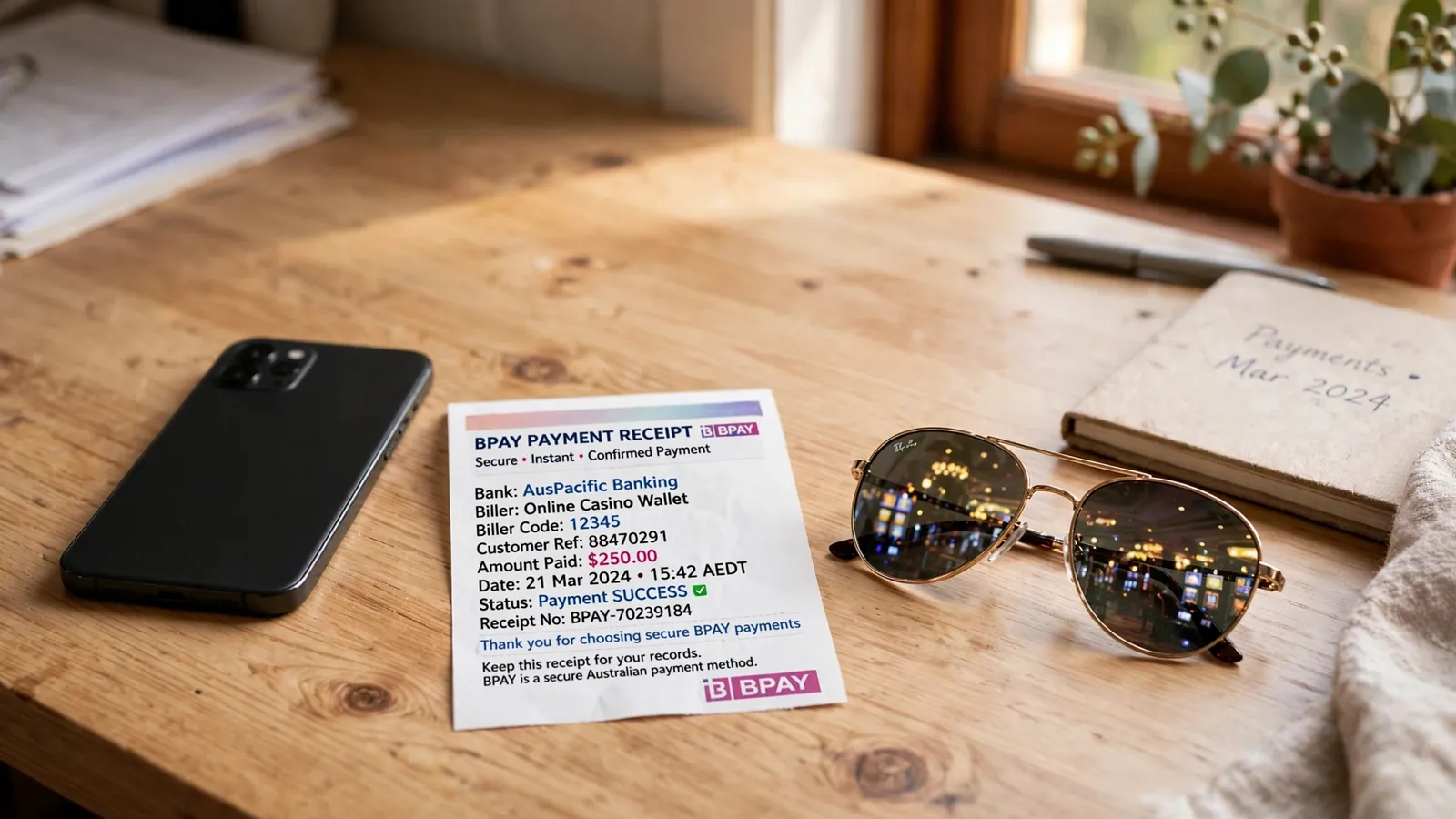
A BPAY logo beside a cashier button can look like a clear answer. It isn’t, on its own. It may show that a site has mentioned the payment method, but you still need to establish whether the option is available to you and what happens when you select it. A graphic on a page and a working payment route are not the same thing.
That distinction matters when you’re trying to work out whether an online casino takes BPAY. A result that names the method does not tell you whether the information is current, whether it applies to Australian customers, or whether the cashier actually offers the option. Those are separate details, and a short label can leave every one of them unclear.
I’d treat the cashier as the place where a payment claim needs to hold up, not as a detail to assume from a headline or logo. Look for BPAY as an available method there, and read the instructions shown alongside it. If the method is not visible, or the instructions do not make clear who can use it, don’t turn a general claim into a certainty. A familiar name is no substitute for a clear, usable option.
If you’re looking for casino sites that accept BPAY in Australia in 2026, check that BPAY is currently available before depositing. Use the details below as a reference, since they do not confirm BPAY acceptance.
Uptown Pokies
You can note that Uptown Pokies has operated since 2017 and lists a minimum deposit of A$20. Its stated licence is from Curacao.
Neospin
You can check Neospin’s stated licensing details: Curacao Gaming Control Board OGL/2023/176/0095, under Hollycorn N.V.
Playfina Casino
You can note Playfina Casino’s Curacao eGaming licence under Hollycorn N.V. and its stated operation since 2017. The minimum deposit is A$20–30, depending on the offer.
JustCasino
You can note that JustCasino is licensed by the Curacao Gaming Control Board.
SkyCrown
You can consider SkyCrown’s stated payout timings: crypto payouts take about 10–15 minutes, while fiat payouts take 1–5 days. Its minimum deposit is A$30, and it is licensed by the Tobique Gaming Commission.
WinSpirit Casino
You can note WinSpirit Casino’s Curacao eGaming licence, OGL/2024/923/0383, under Antillephone N.V. Its minimum deposit is A$30.
Ricky Casino
You can note Ricky Casino’s stated payout times: under an hour for crypto and 1–3 business days for PayID. The minimum deposit is A$20, or A$30 to qualify for the bonus.
Wild Tokyo
You can note Wild Tokyo’s Curacao licence and A$10 minimum deposit. Its stated payout times are 30–60 minutes for crypto and 1–5 days for fiat.
7Bit Casino
You can note that 7Bit Casino is licensed in Curacao and operated by Dama N.V.
MrPacho
You can note MrPacho’s stated payout times: 30–120 minutes for crypto and 24–72 hours for fiat. Its minimum deposit is A$30.
There is another reason to be careful about what a payment label appears to prove. Payment availability is not a general seal of approval, and it does not establish anything beyond the particular payment claim being made. It cannot, by itself, tell you that a site is suitable or that any other detail about it has been checked. Keep the claim narrow: does the cashier show BPAY for your situation, and does the site explain the process plainly?
For Australians, the regulator’s role is also worth keeping straight. The Australian Communications and Media Authority, usually shortened to ACMA, enforces the Interactive Gambling Act. That is a fact about who oversees enforcement; it does not confirm whether a particular cashier offers BPAY. Don’t read a payment logo as an official endorsement. It is simply a payment claim to assess on its own terms.
I’d also be wary of treating repeated mentions as independent confirmation. Several pages can repeat the same claim without showing that the method is available in a cashier. Repetition can make a statement feel settled. It doesn’t make the checkout step any clearer.
So, when you see BPAY attached to an online casino, pause at the exact point where the claim should become practical: the cashier and its instructions. If those do not clearly show the option and how it applies to you, the sensible reading is that acceptance has not been established for your situation. No guesswork needed.
A payment option does not change the legal position of an online casino. In Australia, the central distinction is between the person using a service and the operator providing it. The Interactive Gambling Act 2001 prohibits operators from offering real-money online casino games to people in Australia. That includes casino-style services such as poker and table games, as well as pokies.
The law does not explicitly make it a criminal offence for an individual to use an offshore casino. That is not the same as saying the service is lawful to provide here, or that using it comes with the protections you would expect from a local consumer service. The prohibition is aimed at operators supplying these services to people in Australia.
This difference can be easy to miss when a site is accessible or accepts Australian customers. A working webpage, a familiar payment brand or an Australian-facing description does not establish that the operator is permitted to offer real-money casino gambling in this country. Accessibility is not approval. Offshore operators are subject to enforcement, including efforts to restrict access to prohibited services.
The Australian Communications and Media Authority (ACMA) is responsible for enforcing the Interactive Gambling Act. Its role is not simply to explain the rules; it takes action in response to prohibited services, including measures to block access to offshore casino websites. As a result, a site that appears available at one point may not remain accessible. Nor does an operator’s own claim about its status settle the question under Australian law.
I would keep two questions separate: whether a person faces a penalty for using an offshore site, and whether the operator is allowed to provide the service to Australians. The legal framework treats those questions differently. The absence of an explicit player offence should not be read as a green light for operators, and enforcement against operators should not be confused with a statement that every player is being prosecuted.
There is a practical consequence beyond access. Australian consumer law does not protect players who use offshore casinos. If a dispute arises over an account, a balance or a transaction, you should not assume that Australian consumer protections will provide a route to resolve it. A site may describe its own complaint process, but that does not make it an Australian-regulated casino or give you the protections available in a domestic consumer relationship.
That matters before considering any cashier or payment instructions. A payment method only describes how a transaction might be attempted; it does not establish that the underlying gambling service can lawfully be offered in Australia. The same applies if a site labels itself Australian, displays local currency, or uses wording that sounds tailored to local customers. Those details do not override the Act.
Keep the legal context in view when you encounter claims about an Australian online casino accepting BPAY or another payment method. The question of payment acceptance is separate from whether the operator may offer casino gambling to people here. Neither a logo nor a successful transaction proves that the service is lawful, locally regulated or covered by Australian consumer law.
For an Australian reader, the sensible boundary is clear: do not treat offshore availability as official permission, and do not mistake the lack of an explicit player offence for consumer protection. The operator’s legal position and the player’s exposure are not identical. That distinction is the part worth remembering.
A payment method appearing in one casino’s cashier tells you nothing reliable about what another cashier will offer. The available methods and the conditions attached to them are set at the individual operator level, so a familiar name or logo is not a promise that a deposit will work for you.
That matters if you are looking for a casino deposit by BPAY. Do not treat a payment logo in a search result, a general payment guide or another operator’s cashier as confirmation that BPAY is available at a particular site. The method needs to be shown in that operator’s own cashier, with its current terms. A BPAY option that is not visible there is not something you can infer from the presence of another bank-linked service.
Amex Deposit Process
Selection
Select Amex as the payment method in the casino cashier.
Entry
Enter your card details and the deposit amount in Australian dollars.
Submission
Submit the payment for processing.
Even when a method is listed, the cashier is where the practical details become specific. It may ask for information particular to that method, display a transaction limit, or set out conditions before you submit. Those details can differ between operators and may change. A payment description copied from another site is no substitute for reading the instructions in the cashier you are actually viewing.
Amex offers a useful example of how a deposit flow can work, but it is not evidence that BPAY is accepted. In the described Amex process, the player selects Amex in the cashier, enters the card details and the deposit amount in Australian dollars, then submits the payment. That is a method-specific sequence, not a universal template. A BPAY process, if offered by an operator, could have different instructions; do not assume that the card steps apply to it.
There is another important distinction: seeing a method listed does not ensure that a transaction will be approved. With Amex, a deposit may be declined if the card issuer blocks payments to a particular website. A cashier can show what an operator presents as an option, but it cannot guarantee that the payment will pass the card issuer’s checks. So treat the displayed method as information to assess, not a promise of acceptance.
The practical point is simple: check the exact cashier and the terms attached to the exact method before relying on it. For an Amex example, a specialist review describes deposit and withdrawal limits as set by individual casinos and liable to vary. That is a reason to check the operator’s current terms rather than assume one casino’s limit applies elsewhere. It does not establish any limit for BPAY, or confirm that a BPAY option exists.
Do not read this as an invitation to make a deposit. In Australia, operators are prohibited from providing real-money online casino games to people located here. Australian consumer law also does not protect players who use offshore casinos. A payment workflow cannot change that position. I would treat any claim about an available deposit route cautiously, especially if it encourages you to move money before you have understood the legal and financial risks.
If you are checking a cashier for general information, keep the questions separate: is the method actually listed; what information does it request; what conditions does the operator state; and does the issuer permit the transaction? One operator’s answer cannot settle those questions for another. Nor does a successful-looking first screen establish that a payment will be approved once submitted.
Cashiers are not interchangeable. The Amex example shows why: even a clearly described card process depends on the particular method and the operator’s terms. It cannot be used to fill in the missing details for BPAY. Check what is explicitly stated, and do not assume that a deposit method is available simply because another casino, payment page or review mentions it.
“Instant” can describe money going into an account, money coming out of it, or simply a label on a payment option. Those are different stages, and one timing claim cannot be carried across to another. A quick deposit does not establish a quick withdrawal; nor does a timing claim for one payment method tell you how another will work.
An Amex example makes the distinction clear. A specialist review describes casino deposits made with Amex as being processed instantly. That is a claim about the deposit side of the transaction. It does not tell you how long a withdrawal takes, and it does not guarantee that funds will appear instantly in every account or under every operator’s conditions.
The same specialist review puts Amex casino withdrawals in a different category: they can take up to five days to clear. That is a reported timeframe, not a promise that every withdrawal will take that long or a guarantee that it will be completed within that period. It also should not be read as an account of how BPAY withdrawals work. The method is different, and the Amex timing gives you no basis for assigning BPAY a processing speed.
When you see an “instant” payment claim, check which direction it describes. A deposit is money moving towards an account; a withdrawal is money being sent away from it. The word “instant” attached to the first says nothing by itself about the second.
It is easy to blur the two, especially when a payment description sits beside a general statement about cashing out. Keep the claim narrow: if it refers to deposits, treat it as a deposit claim. If it refers to withdrawals, look for wording that specifically covers withdrawals. If the description does not make the direction clear, it is not enough to establish either timing.
Even within one method, timing statements need careful reading. “Processed instantly” is not the same wording as “withdrawn instantly.” The first concerns the processing of an incoming payment; it does not establish when outgoing funds are cleared. A withdrawal may have a separate process and a different stated timeframe. Keep those clocks apart.
For BPAY, don’t borrow Amex’s timing as a shortcut. The available Amex example cannot tell you whether a BPAY payment would be processed immediately, take longer, or be offered at all. A cashier label or a general “fast payments” statement would need to specify the method and the direction before it could answer a timing question. Without that distinction, “instant” is just a broad word, not a useful estimate.
That matters if you are comparing claims about fast deposits with claims about instant withdrawals. They are not interchangeable descriptions. One may refer to money being accepted into an account; another would have to describe money leaving it. A claim about one does not prove the other. Small distinction. Big difference.
The five-day figure in the specialist review belongs only to its Amex withdrawal statement. It should not be converted into a general rule for casino withdrawals, or used to estimate the time for BPAY. Likewise, the reported instant Amex deposit processing does not establish that every Amex deposit—or any BPAY deposit—will be completed at the same speed. Keep the method and transaction direction attached to any timing you read.
There is also a broader point about the word “instant”: it can sound like a complete description when it only refers to one part of a transaction. A claim may describe processing but say nothing about when money is usable or cleared. Unless the wording explains what event is happening instantly, don’t assume it answers the whole timing question.
For readers in Australia, this is not an endorsement of using offshore casino services. The Interactive Gambling Act 2001 prohibits operators from providing real-money online casino games to people in Australia, and Australian consumer law does not protect players who use offshore casinos. A payment-speed claim does not change that legal and consumer context.
So keep the comparison simple: the specialist-review example reports instant processing for Amex deposits and a possible clearance period of up to five days for Amex withdrawals. Neither statement gives BPAY a speed, and neither turns an incoming-payment time into an outgoing-payment promise. If the method, direction and meaning of “instant” are not stated together, the timing claim leaves too much unanswered.
“Best” is a ranking, not a payment feature. To earn the label, a comparison would need to identify the operators being compared and show that each one actually offers BPAY to Australian customers. Without that, a best-BPAY-casino claim tells you nothing reliable about whether the method is available at the named site.
I would also want the comparison to be specific about what it means by “best”. Is it comparing payment availability, or folding in unrelated features? A polished page, a bonus headline or a prominent BPAY logo cannot establish that a cashier will offer the method. Nor does a broad claim about a casino’s payment options confirm what is available to a particular customer.
Visa is a useful contrast, but only a narrow one. A specialist review has suggested that Visa may be more broadly accepted at Australian online casinos than Amex. That does not verify BPAY acceptance anywhere, and it is not a guarantee about every operator. It simply shows why payment-method claims need to be kept method-specific: information about Visa does not carry across to BPAY.
The same goes for labels such as “top site” or “best website”. Those words can make a page sound decisive while leaving the key point unanswered: does the operator’s own cashier actually show BPAY? If a page names no operators, it is not a usable list. If it names them but offers no clear basis for its ranking, the ranking is still just a claim.
I’d treat a bonus attached to a BPAY search as a separate claim, too. A promotion does not prove that BPAY is supported, and a payment logo does not establish the terms of a bonus. Don’t let one headline stand in for the other. Convenient, but not evidence.
A sound comparison would make its scope plain: which named services were checked, whether BPAY appeared as an available method, and when that information was confirmed. It would distinguish an operator’s own cashier information from a review’s description, rather than presenting both as equally direct proof. Payment options can change, so a past mention should not be read as confirmation of what a cashier offers now.
If you cannot find a current, operator-specific basis for the claim, don’t rely on the word “best” to fill the gap. Treat it as an unconfirmed description, not a recommendation or proof that BPAY will work.
A payment method and a casino’s game catalogue are two separate things. Seeing BPAY mentioned beside a casino name would not tell you what that operator makes available, and a page about casino games does not establish that BPAY can be used to pay. The connection is easy to assume from a label or a search result. It is not a reliable one.
I’d treat “BPAY casino games” as two questions, not one: is the payment method actually offered, and what does the operator’s site say about its services? A reference to BPAY does not answer the second question. Nor does a list of games confirm that BPAY is among the cashier’s payment options. Don’t let one label do the work of checking both.
There is another practical distinction: an account may need to pass identity checks before financial activity is allowed. Online casinos commonly ask customers to complete a Know Your Customer review before processing financial transactions. That check concerns the customer and the account; it does not establish which payment methods or games are available. A payment option appearing in a cashier, where one is offered, is not proof that every service on the same site is accessible to you.
This matters when you come across wording such as “games with BPAY” or “BPAY payment options.” Those phrases can make a payment method sound like a feature of particular games. It isn’t. A payment method is a way of moving funds; it does not attach itself to one part of a catalogue or reveal the operator’s full offering.
Keep the claims narrow. A mention of BPAY is only a claim about payment, and even that needs to be checked directly with the operator. It says nothing by itself about game availability, account approval, or the terms that apply. Likewise, game-related wording cannot confirm a BPAY casino payment route. Separate the questions and check each statement in its proper place.
That may feel like an overly careful distinction, but it prevents a familiar slip: reading a payment label as a promise about the whole site. The cashier, account checks and service descriptions answer different questions. Keep them separate. No shortcuts.
Tap-and-go is part of ordinary life in Australia. Contactless credit and debit cards are accepted in nearly every corner of the country, and mobile wallets including Google Pay and Apple Pay are similarly common. People are also comfortable moving between cards, phone-based payments and services connected to bank accounts, such as PayPal.
That tells you something about everyday payment habits. It does not tell you what a particular online cashier supports. Familiarity with tap-to-pay, or with moving money through a bank-linked service, is no evidence that an Australian casino accepts BPAY. Nor does seeing BPAY used for household bills or other purchases establish that it can be used for a gambling transaction.
I’d keep those categories separate. A payment method can be widespread in shops and still be absent from a particular online service. Even when a cashier displays a familiar option, availability can depend on that operator’s arrangements and the account in front of you. General Australian habits cannot settle those details.
So if you’re trying to establish whether an online casino accepts BPAY, don’t treat the popularity of contactless cards, mobile wallets or bank-linked services as a substitute for checking the relevant cashier. Those habits explain why people may expect familiar ways to pay; they don’t confirm that expectation. A tidy assumption, but still an assumption.
There is another distinction worth keeping in view: payment familiarity does not make an offshore casino a locally protected service. Australian consumer law does not protect players who use offshore casinos. That is separate from how Australians pay for everyday goods and services, and it should not be blurred with the question of which payment options appear in a cashier.
In short, Australia’s comfort with digital and card payments is useful context, not proof of BPAY acceptance. Don’t infer that an Australian casino supports BPAY just because Australians readily use other payment methods. Only the operator’s current cashier information can tell you what it offers to your account.
A payment option shown for deposits does not automatically mean it can receive a withdrawal. The cashier may treat incoming and outgoing payments differently, so check the withdrawal terms before you rely on any particular route.
That matters if you are looking for a casino with BPAY withdrawal. A BPAY logo or deposit option, where shown, would not by itself confirm that winnings can be sent back through BPAY. The same applies to an online casino that lists BPAY in its cashier: deposit availability and withdrawal eligibility are separate details to verify. Don’t treat a payment label as the whole answer.
Amex is a useful example of why the distinction matters. A specialist review reports that not all Australian online casinos allow withdrawals to Amex. That is a claim about a specific payment method, not proof of any casino’s BPAY arrangements. It also may not reflect a particular operator’s current terms, so check the cashier and the withdrawal conditions for the account you are considering.
Look for the permitted withdrawal methods, any conditions attached to them, and whether the method must have been used for a deposit first. If the terms do not clearly explain whether BPAY can receive a withdrawal, ask the operator for a direct answer before putting money in. Keep the response and the relevant terms so you can refer back to what was stated.
If BPAY is not listed for withdrawals, do not assume a deposit through it can be returned by the same route. Find out what alternative withdrawal methods are available and whether you can use them. If you cannot establish a workable route for receiving funds, pause rather than guessing.
There is a wider Australian point, too: consumer law does not protect players who use offshore casinos. That makes it especially important not to rely on a payment logo or an unclear promise when deciding how funds could be returned.
Check first. No guesswork.
A BPAY label in a page or payment graphic is not enough to establish that a payment will work. If you are checking a cashier, look for the method in the actual payment options and read the terms attached to it. Availability, fees and transaction limits are separate details; one does not tell you the others.
For BPAY, do not assume anything about acceptance, charges, minimums, maximums or processing conditions. Confirm each point in the relevant terms before relying on it. If the cashier does not show clear, method-specific information, you do not have a sound basis for treating BPAY as an available option. Don’t guess.
Amex illustrates why the fine print matters, but it says nothing about BPAY. A specialist review reports that Amex deposits may have no fee, while fees can depend on the casino and withdrawals may incur charges. The same type of review notes that some casinos may not return winnings to Amex or may charge an additional withdrawal fee. Those are claims about Amex, not a template for BPAY terms.
Check whether any stated fee applies to a deposit, a withdrawal, or both, and whether the limit is set per transaction or in another way. Make sure you are reading the current cashier terms, not relying on an old payment logo or a general statement about a method. If the information is unclear, pause rather than sending money and hoping the conditions work out.
There is a wider point worth keeping in view: Australian consumer law does not protect people who use offshore casinos. This is not a recommendation to use one or a suggestion that a payment option makes it safe or lawful. The practical lesson is narrow: never infer BPAY acceptance or its conditions from another method’s rules, and do not proceed on an assumption.
When a page puts online pokies and BPAY in the same headline, the pairing can sound like a payment claim. It is not one by itself. A games-related phrase tells you what someone is looking for; it does not establish what a casino’s cashier accepts.
Keep the two details separate. A site may describe its games, while payment information appears elsewhere and may depend on the operator’s current cashier options. Unless BPAY is explicitly shown as an available method in the relevant payment information, wording about games that take BPAY is not enough to rely on. A heading can join two terms neatly. It cannot make them verified.
I’d also be wary of treating a general statement about one payment method as evidence about another. A specialist review has reported that some online casinos do not accept Amex, but that tells you nothing about BPAY at any particular site. Payment methods are not interchangeable labels.
So, if you arrive at a page through wording about BPAY and online slots, pause before assuming the result confirms both. Look for a direct, current statement about BPAY in the cashier information, rather than inferring acceptance from the games mentioned around it. If that detail is absent or unclear, the phrasing has not answered the practical question.
Two topics, not proof.
Check the casino cashier for American Express, then select it and see whether it lets you enter your card details and deposit amount in AUD.
Limits are set by each casino and can vary. Check the cashier or the casino’s payment terms for the limits that apply.
You’ll typically need to complete the casino’s Know Your Customer checks before making financial transactions. This does not necessarily mean a separate Amex card verification.
Check with American Express or your card issuer, as they may block gambling payments to a particular website. Australian banks may also block gambling-related Amex transactions.
Some casinos allow Amex withdrawals, but others do not; you generally need to have deposited with Amex first. Withdrawals can take up to five days to clear, and fees may apply.
Jackpot City Casino, Spin Palace, Ruby Fortune, Ignition Casino, Joe Fortune, and PlayAmo are listed as accepting Amex deposits for Australian players.
Amex casino deposits are processed instantly. Withdrawals can take up to five days to clear.
Prepared by the VegasNow Casino editorial staff.